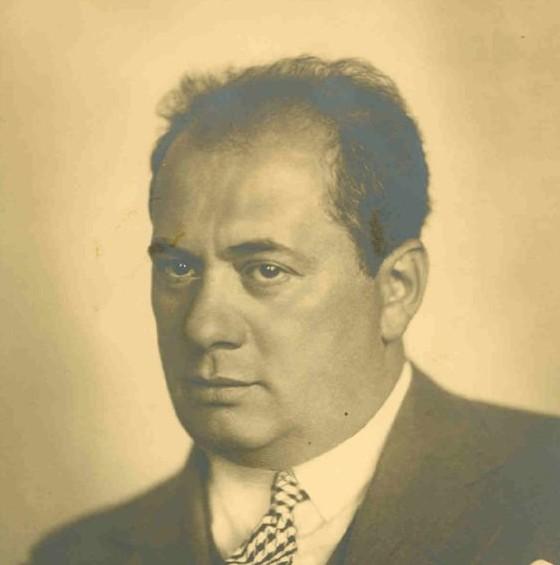
Essay
Why did Ignatz Waghalter become unknown?
History, Ideology, and the Politics of Music in the Twentieth Century
David Green · 2026
I. The Question of a Forgotten Composer
The life of Ignatz Waghalter presents, in unusually concentrated form, one of the central tragedies of twentieth-century music: the destruction, displacement, and subsequent erasure of artists whose work did not conform to the dominant political and aesthetic narratives of their age. Waghalter was not merely a forgotten composer. He was a forgotten type of composer—a melodist, a man of the theater, a cosmopolitan Jewish musician formed in the late-Romantic world of Central Europe, and an artist whose deepest convictions were universalist. His fate cannot be explained by the facile judgment that his music “went out of fashion.” Fashion itself must be explained. What forces determined that certain forms of musical expression were treated as historically legitimate, while others were condemned as obsolete, sentimental, or naïve? Why does the question of who survives in the canon belong less to aesthetics than to history?
These questions are not merely biographical. They are theoretical. Any serious assessment of Waghalter must begin by recognizing that the formation of a musical canon is not a transparent record of merit. It is a historically conditioned social and institutional process shaped by publishers, conservatories, opera houses, conductors, critics, patrons, recording companies, broadcasters, state policies, and the migrations and catastrophes of political history. To treat survival in the repertoire as proof of quality, and disappearance as proof of inferiority, is to mistake the outcome of historical struggle for the verdict of disinterested judgment. Waghalter’s case is valuable precisely because it exposes the mechanisms by which such verdicts are produced.
II. Formation and Rise: Warsaw to Berlin
Waghalter’s biography resists the conventional categories. Born in Warsaw in 1881 into a poor but intensely musical Jewish family, he made his way to Berlin as a young man and entered the world of German musical culture. He studied under Friedrich Gernsheim and benefited from the encouragement of Joseph Joachim, the great violinist and intimate of Brahms. His early works—the String Quartet in D major, the Violin Sonata, the Violin Concerto—already revealed the qualities that would define his music: an unforced melodic gift joined to solid technique and an instinct for direct emotional communication.
His career as a conductor developed rapidly. At the newly opened Deutsches Opernhaus in Charlottenburg, the predecessor of today’s Deutsche Oper Berlin, Waghalter became a major figure. He conducted the theater’s first performance in November 1912 and, in 1913, led the German premiere of Puccini’s La Fanciulla del West, reportedly at Puccini’s own insistence. He remained associated with the Deutsches Opernhaus until 1923, a period that included the premieres of his major stage works.
Waghalter’s operatic ambitions were substantial. His catalogue includes Der Teufelsweg, a music drama in three acts; Mandragola, a comic opera after Machiavelli; Jugend, a lyrical opera; Sataniel, a comic fantasy opera; Der späte Gast, described as a play opera; Der Weiberkrieg, a historical operetta; Bärbel, a comic operetta; Lord Tommy, a “melodic comedy”; Ahasaverus and Esther; and the late fantasy operetta Ting-Ling. The range is striking. Waghalter moved between serious opera, comedy, operetta, chamber music, song, orchestral works, and film-related music—not as a dilettante but as a musician with an unusually broad theatrical and melodic imagination.
III. The Conductor: An Outstanding Career in Its Own Right
Before the essay proceeds to its central question—what kind of composer Waghalter was, and why his music disappeared—the scale and quality of his conducting career must be set out plainly. To treat his work on the podium as mere biographical background is to distort the evidence in two directions at once. It understates the stature from which his compositional career was conducted, and it misrepresents the nature of his disappearance, which extends to his conducting as fully as to his compositions. Waghalter was not a composer who occasionally led an orchestra. He was, on the available evidence, one of the outstanding operatic conductors of his generation, and he has been almost as thoroughly forgotten in that capacity as in any other.
The facts are emphatic. On November 7, 1912, the newly constructed Deutsches Opernhaus in Berlin-Charlottenburg opened its doors with a performance of Beethoven’s Fidelio conducted by the thirty-one-year-old Waghalter. His appointment to open the house—the second-largest opera theater in Germany—was itself a remarkable event. That a Polish-born Jew should be entrusted with so conspicuous a national occasion provoked a campaign of denunciation from nationalist and antisemitic circles, and both Waghalter and the Intendant, Gregor Hartmann, received death threats in the weeks before the premiere. Hartmann refused to capitulate. The opening went ahead as planned, and Waghalter’s direction of Fidelio was praised in the Berlin press. He would retain the leading conductor’s post at the Deutsches Opernhaus for eleven years, from 1912 to 1923, a tenure of a length and continuity that in itself indicates the quality of the work performed. Great opera houses do not keep their principal conductors for more than a decade unless the artistic results demand it.
His relationship with Puccini was decisive for the German reception of the Italian master, and it is not too much to say that Waghalter was substantially responsible for that reception. In 1913 he led the German premiere of La Fanciulla del West at the Deutsches Opernhaus, at Puccini’s own explicit insistence—the composer having negotiated the choice of conductor as a condition of the premiere. The performance drew seventy curtain calls for composer and conductor together: a measure of public response rarely equaled in the history of German operatic premieres. Later the same year Manon Lescaut – which was poorly received when first performed in Berlin – was revived under Waghalter’s baton at the Deutsches Opernhaus with extraordinary success. In an environment in which Italian verismo was treated by influential sections of the German musical establishment as beneath the dignity of serious opera, Waghalter’s advocacy and interpretive authority did as much as any single musician’s to secure Puccini’s place in the German repertoire. This was not secondary work. It was central to the musical history of the period.
His career did not end with the collapse of the Deutsches Opernhaus. When the 1923 inflationary crisis forced the house into bankruptcy, Waghalter traveled to the United States and was appointed General Music Director and principal conductor of the New York State Symphony Orchestra. On his return to Europe in late 1925, he was named General Music Director of the Ufa film studios—then the largest film production company in Europe—and composed the original score for Hanns Walter Kornblum’s Wunder der Schöpfung, a work later acknowledged by Stanley Kubrick as an inspiration for 2001: A Space Odyssey. In 1930 he spent six months in Moscow conducting at the Bolshoi Opera. He was then appointed General Music Director and principal conductor of the National Opera of Latvia. He returned to Berlin only in late 1932, months before the Nazi accession to power closed his German career entirely. This is the trajectory not of a regional specialist but of a musician who worked at the highest level of operatic and symphonic conducting across Central Europe, the Soviet Union, and the United States, in a period during which such mobility at such a level was the preserve of a small number of figures.
Waghalter also left behind a substantial body of recordings, made between 1924 and 1926 with the orchestra of the Städtische Oper—the reconstituted Deutsches Opernhaus—and these recordings permit the listener to assess his work directly, without depending on contemporary reviews alone. The repertoire of the surviving discs is broad and tellingly chosen: overtures and extended fantasies from Mozart (Figaro, Die Entführung, the Minuet from Symphony No. 39), Rossini (Wilhelm Tell, La gazza ladra), Verdi (Rigoletto), Puccini (La Bohème), Mascagni (Cavalleria rusticana), Gounod (Faust), Mendelssohn (A Midsummer Night’s Dream), Offenbach (Orpheus in the Underworld, Hoffmann), Strauss (Die Fledermaus), and D’Albert (Tiefland). What emerges from these recordings, for those who take the trouble to hear them, is the work of a conductor of considerable interpretive seriousness: rhythmically alert, structurally lucid, attentive to orchestral color and to the dramatic shape of a phrase, and free of the heaviness that afflicted much German conducting of the period. The recordings are the work of a modernist in the good sense of the term—a conductor who had absorbed the lessons of precision and clarity that the best twentieth-century orchestral practice was beginning to demand—while preserving the expressive warmth that the Italian repertoire in particular required. They are, taken together, a major document of interwar European conducting, and they have been almost entirely ignored by the historiography of that conducting tradition.
This neglect is itself revealing, and it bears on the argument of the essay as a whole. The canon of great early-twentieth-century conductors as it has been transmitted to us—Furtwängler, Walter, Klemperer, Toscanini, Beecham, Mengelberg, Kleiber, and a handful of others—was constructed under the same postwar conditions that shaped the musical canon more generally. It privileged those whose institutional continuity survived the catastrophes of 1933 and 1945; those whose recordings were preserved and reissued by the major postwar labels; and those whose reputations were stewarded by critics and scholars with access to the dominant channels of publication. Waghalter, whose Berlin tenure ended in 1923, whose subsequent appointments were in institutions destroyed or dispersed by the war, whose American career never achieved the institutional anchorage of a Walter at the New York Philharmonic, and whose recordings sat in private hands for decades, fell outside every one of these transmission mechanisms. His name dropped out of the reference works. The recordings were not reissued. The reviews were not assembled. The oral tradition in the conservatories and the orchestras, on which so much of conducting reputation depends, did not carry him forward. He was, in short, subjected to the same processes of structural erasure that removed his compositions from the repertoire, and by largely the same means. The forgetting of Waghalter the conductor and the forgetting of Waghalter the composer are not two separate phenomena. They are a single event.
This is the sense in which the present essay’s focus on the compositional career, however appropriate, must not be allowed to leave the conducting career in shadow. Waghalter’s compositional output was the work of a musician who stood at the center of the European operatic world for over a decade, who was trusted by Puccini with the fate of his music in Germany, who led the orchestra of one of the great houses through performances that his contemporaries judged at the highest level, and who left recorded evidence of the kind of interpretive sensibility that formed his compositional voice. The music he wrote was the music of that musician. The recovery of one cannot be fully separated from the recovery of the other.
IV. A Composer Who Conducted: Waghalter and the Conductor-Composers of His Era
To grasp Waghalter’s position accurately, it is necessary to draw a distinction that is too rarely made, but that goes to the heart of any serious assessment of his work. Waghalter was a composer who conducted. He was not a conductor who composed. The difference is not a matter of biographical emphasis; it is a difference in artistic identity, in creative center of gravity, and in the kind of musical judgment one is entitled to make about the resulting work.
The early-twentieth-century musical world produced a number of distinguished conductors who also wrote music, and the temptation to assimilate Waghalter to this category should be resisted. Bruno Walter, almost exactly Waghalter’s contemporary, composed two symphonies, a violin sonata, songs, and incidental music. He worked seriously at composition into his early thirties and then, in effect, abandoned it. His First Symphony in D minor of 1907 was received coolly by Mahler, performed only once more in his lifetime, and then disappeared until Leon Botstein revived it nearly a century later. The recording of that revival has been received politely rather than enthusiastically, and the consensus of those who admire Walter’s conducting is that his compositions are derivative late-Romantic works that do not approach the level of his interpretive art. They are heard today as a curiosity—as evidence of what the great Mahler conductor was thinking when he was young—not as music with an independent claim on the repertoire.
Otto Klemperer, slightly younger, composed across his entire life: six symphonies, nine string quartets, a Missa Sacra, around a hundred songs, and an opera. He took composition lessons from Schoenberg in Los Angeles, and he stated openly that he wished to be remembered as a composer rather than as a conductor. Posterity has not granted that wish, and on hearing the music it is not difficult to understand why. Only the Merry Waltz, an excerpt from his unfinished early opera Das Ziel, has had even a modest independent life. The symphonies, written largely in old age, are the work of an intelligent musician who never solved the basic problems of large-scale construction; their themes are pithy but their structures wander, and one can hear the hand of a man whose musical mind was formed in the rehearsal room rather than at the writing desk. Furtwängler’s symphonies, vast and earnestly Brucknerian, suffer from a related problem: they are the work of a great conductor reaching for compositional ambitions his technique cannot quite carry. Celibidache, more honest about his own situation, eventually withdrew most of his compositions from circulation.
The reasons for this pattern are not mysterious. Conducting and composition are different disciplines, and mastery of one does not entail even competence in the other. The conductor who composes typically does so in time stolen from the podium—between rehearsals, on tour, in the late summers between seasons. His ear has been formed by the daily handling of the masterpieces, which is at once an advantage and a trap. The advantage is technical fluency; the trap is that one’s own work tends to sound like an unconscious anthology of the music one has just been conducting, without the necessary distance to find an independent voice. Walter’s symphony has been described, accurately, as proto-Berg with Mahlerian fingerprints; Klemperer’s symphonies betray, beneath their angularity, the shadow of the Beethoven and Bruckner he had spent a lifetime preparing. These are not failures of intelligence or seriousness. They are the structural consequences of a divided artistic life.
Waghalter’s case is categorically different, and the difference is visible at every level of his career. He was trained as a composer—under Friedrich Gernsheim, with Joachim’s endorsement—before he ever held a baton professionally. His earliest mature works are chamber and concerto pieces, not arrangements or transcriptions made out of conducting practice. His major operas were premiered while he was at the height of his conducting career and were the principal product of his creative life, not its sideline. His catalogue runs to dozens of works across opera, operetta, chamber music, song, and orchestral writing, sustained over four decades and continued in exile when he had no podium at all. The conducting was, at its peak, brilliant—he led the German premiere of La Fanciulla del West at Puccini’s own request—but it was the practical extension of a fundamentally compositional musicianship, not a substitute for one. The American exile, which severed his institutional access to conducting almost entirely, did not silence him as an artist. It produced the Negro Symphony Orchestra, the New World Suite, and the late operetta Ting-Ling. A conductor who composed in the manner of Walter or Klemperer would have fallen silent under those conditions, because the conducting life had been the source of the compositional impulse rather than its servant. Waghalter did not fall silent.
This distinction has direct consequences for how his music should be heard, and how its rediscovery should be framed. The revival of Walter’s symphony is properly understood as an act of historical curiosity—a glimpse of a great interpreter’s youthful ambitions, valuable for what it tells us about him rather than for what it adds to the repertoire. The revival of Klemperer’s symphonies serves a similar function. The case for Waghalter is different in kind. He must be heard as one hears any composer of his generation—as a maker of works that stand or fall on their own musical merits, not as documentary evidence about a more famous parallel career. He was a musician whose primary claim on history is the music he wrote, and whose disappearance from the repertoire is therefore a loss of a different order than the disappearance of the conductor-composers’ occasional pieces. To conflate the two is to miscount what was lost when Waghalter was forgotten, and to misunderstand what is being recovered when his works return.
V. Jugend and the Anatomy of a Disappearance
The central work in this trajectory was Jugend. Based on Max Halbe’s celebrated realist drama, the opera was premiered at the Deutsches Opernhaus in February 1917, in the midst of the First World War. It told of the destruction of young love, and its emotional theme inevitably acquired a broader resonance in a society being consumed by violence. The work was not a marginal success. It was performed more than forty times in the following three years, and critics singled out the power of Waghalter’s melodic invention. One reviewer compared the climactic love duet to one of the great moments in Verdi’s Aida—an extravagant comparison, perhaps, but one that registers the impression the opera made.
The disappearance of Jugend is therefore not the story of a failed work that quietly vanished. It is the story of a successful work that lost its institutional basis. This distinction is decisive, and it sharpens a point that runs through any honest theory of cultural memory. Many forgotten operas disappear because they never establish a public. Jugend did. Its oblivion came not before recognition, but after it. The case must therefore be analyzed not in terms of intrinsic appeal but in terms of the conditions under which appeal can be sustained, transmitted, and reproduced. A repertory is not a record of works that pleased; it is a record of works whose institutional conditions of transmission survived.
The causes of the collapse were multiple and they accumulated. The First World War shattered the Europe in which Waghalter’s art had been formed. The postwar inflationary crisis devastated the bourgeois subscription public on which serious German opera depended, and with it the financial scaffolding of the houses that performed contemporary work. In 1923, the bankruptcy and reorganization of the Deutsches Opernhaus weakened the artistic structure in which he had played a leading role. Sataniel, premiered that same year, encountered a far less hospitable climate, which Waghalter himself attributed in part to nationalist hostility toward its Polish source material. The change was not merely financial or administrative. The political atmosphere was turning against him. He was a Polish-born Jew in a German cultural environment increasingly poisoned by an antisemitism that would soon become state ideology.
VI. The Aesthetic Ideology of the Postwar Era
But the fate of Waghalter cannot be explained by antisemitism and exile alone, central as these were. His music was also caught in the great aesthetic conflict of the twentieth century, and any honest reckoning with his disappearance requires that this conflict be examined theoretically rather than merely descriptively. Waghalter remained committed to melody, lyricism, tonality, and theatrical communication. The “problem” with his music, from the standpoint of the dominant postwar critical consensus, was precisely that it sought to move the listener. It did not renounce beauty. It did not treat the singing line as a compromised inheritance. It did not accept the proposition that difficulty, fragmentation, and alienation were the defining marks of historical seriousness.
To understand the force of that consensus, one must grasp how thoroughly it transformed the criteria by which musical value was assessed. In the decades after 1945, especially in the German-speaking world, late-Romantic musical language was viewed with deep suspicion because it had been appropriated, sentimentalized, and ideologically weaponized by National Socialism. Wagner, Bruckner, Strauss, the entire culture of monumental tonal expression had been pressed into the service of a regime whose crimes were unprecedented. Conversely, the modernist and atonal traditions, which the Nazis had condemned as “degenerate,” acquired in defeat an aura of moral purification. Alex Ross has described this postwar syllogism with admirable bluntness: if Hitler liked it, it must be bad; if Hitler hated it, it must be good. That logic, however historically intelligible, was a category error. It transferred a moral verdict from political actors to musical materials, treating idioms as if they bore intrinsic guilt or innocence. By that confusion, an entire stratum of musical practice—lyrical, tonal, theatrically communicative—was placed under suspicion, and composers like Waghalter, who had themselves been victims of fascism, were swept up in the indictment of the very idiom in which they had worked.
The intellectual articulation of this climate found its most influential voice in Theodor Adorno. Adorno’s Philosophy of New Music (1949) elevated Schoenberg’s rupture with tonality into something close to a historical necessity. For Adorno, the immanent logic of musical material had reached a point at which the consonance, resolution, and melodic continuity of the tonal tradition could no longer be employed in good faith. To use them was to lie—to offer the listener a reconciliation that history had revoked. Music that preserved familiar beauty, melodic continuity, or tonal fulfillment thus appeared not merely old-fashioned but ideologically suspect, an accomplice of the false consciousness produced by the culture industry. The argument was philosophically powerful and politically serious. It was also, in its institutional consequences, extraordinarily narrowing.
It is essential not to caricature Adorno or the postwar avant-garde. Adorno’s analysis identified something real: the catastrophic difficulty of writing tonal music after the catastrophe, the way in which inherited gestures of consolation could function as evasions of historical reality. Schoenberg, Berg, Webern, Stravinsky, Bartók, Shostakovich, Britten, Prokofiev, and many others responded in profoundly different ways to the crisis of musical language in the twentieth century, and their achievements are not in question. The issue is not whether modernism produced masterpieces. It did. The issue is whether the ideology of modernism—especially in its postwar academic and institutional forms—generated a distorted canon in which melody itself, as a category of musical thought, became epistemologically suspect: not merely unfashionable, but inadmissible as evidence of seriousness.
That distortion had specific institutional carriers. The Darmstadt summer courses, the West German radio orchestras, the principal European new-music journals, the conservatories that trained the next generation of composers, the funding bodies that commissioned new work—these institutions, in the two decades after 1945, were oriented overwhelmingly toward the post-Webern serial avant-garde and its successors. Composers who continued to write in tonal or lyrical idioms found themselves outside the channels through which postwar legitimacy was conferred. They were not formally banned. They were rendered historiographically invisible. The histories written in this period treated tonality as a closed chapter, and treated those who continued to work within it as residues of a superseded epoch. This was, in effect, a Whig history of musical language, in which the past was reorganized as a teleological march toward the present’s methods. Such histories always misread the past, because they convert contemporaries into precursors and dissenters into anachronisms.
Waghalter suffered exactly this fate. His music did not disappear because it lacked craftsmanship, feeling, or public appeal. It disappeared because the qualities it possessed were declared historically backward. His very virtues became evidence against him. Melodic abundance was redescribed as “sentimentality.” Accessibility was redescribed as “banality.” Emotional directness was redescribed as “naïveté.” The capacity to write a tune that lodged itself in the memory became, in certain circles, a mark of inferiority—as if the durability of a melodic phrase in the mind of a listener were a symptom rather than an achievement.
Such judgments were not only artistically narrow; they were historically false. They confused a particular intellectual response to the crisis of European modernity with the only legitimate response. They mistook one inheritance—the Schoenbergian—for the whole of musical seriousness. They forgot that opera, above all, cannot live without the human voice, without dramatic situation, without remembered gesture, without emotional concentration. Waghalter’s music belonged to a lineage in which melody was not ornament but thought—musical thought in its most immediate and communicable form. His idiom drew on German Romanticism, Italian opera, Polish lyricism, and Jewish musical inflection. That synthesis was not a weakness. It was the basis of his individuality.
VII. The Stage Works and the Theory of “Minor” Forms
Mandragola, premiered in 1914, was a comic opera of genuine promise. Contemporary criticism praised Waghalter’s ability to avoid the heavy-footedness of post-Wagnerian imitation and to write with rhythmic vitality, melodic ease, and theatrical wit. The outbreak of the First World War disrupted plans for a wider European life for the work. Jugend, three years later, confirmed that Waghalter could write serious opera with public impact. Der späte Gast, Der Weiberkrieg, Bärbel, and Lord Tommy show his continuing turn toward forms that required stage instinct, melodic fluency, and command of popular theatrical language.
The reflexive demotion of these latter works as “lesser” forms is itself a symptom of the ideology under examination. The hierarchy that places serious opera unambiguously above comic opera, and comic opera above operetta, is not a neutral aesthetic ordering. It is a class hierarchy and a metaphysical one—inherited from nineteenth-century distinctions between high and low, sacred and profane, autonomous art and mere entertainment—which the modernist sensibility intensified rather than dissolved. In the world of German-speaking musical theater, however, the borders between opera, comic opera, and operetta were artistically porous. Mozart, Strauss, Korngold, Lehár, and Weill all crossed them. Waghalter’s career crossed them because his central gift—the shaping of musical character through melody—was applicable to all of them. To dismiss the operettas as concessions, or the comedies as recreations from “serious” work, is to mistake a sociological prejudice for a musical judgment.
VIII. American Exile and the Negro Symphony Orchestra
The charge of being “old-fashioned” is particularly inadequate in Waghalter’s case because his artistic outlook was anything but provincial. This becomes clearest in his American exile. Driven from Germany by Nazism, Waghalter arrived in the United States not merely as a displaced European musician seeking refuge, but as an artist who intervened directly into the cultural and political life of his new country. His role in the creation of the Negro Symphony Orchestra was one of the most remarkable episodes in his biography—and one that reframes the entire question of his alleged conservatism.
The orchestra, active in Harlem from 1937 to 1940, was a serious attempt to create a permanent classical symphonic institution of Black musicians. Its significance extended beyond music. It brought together the struggle against American racism with the experience of European Jewish exile. It represented, on a major scale, a collaboration between Black cultural forces and a Polish-Jewish refugee from fascism. Recent historiography describes it as unique in its effort to build a permanent structure within Black civil society, and as a rare example of Black-Jewish collaboration in classical music on this scale. Waghalter’s own credo was unequivocal: “Music, the strongest citadel of universal democracy, knows neither color, creed, nor nationality.”
This was not a decorative humanism. Waghalter acted on it. Having been persecuted as a Jew and a foreigner in Europe, he recognized in the exclusion of African American musicians from American classical institutions another manifestation of the same reactionary social logic that had driven him from Berlin. He sought to demonstrate, in practice, that the heritage of classical music belonged to all humanity—not as an abstract slogan, but as an organizational fact. The orchestra admitted women as well as men; Mildred Franklin served as concertmaster, an extraordinary fact in the racial and gender conditions of American musical life in the late 1930s. The Negro Symphony Orchestra was thus not a biographical footnote. It was the practical expression of Waghalter’s artistic worldview: the proposition that the universalist claims of European art music must be redeemed by genuinely universal access, or else stand exposed as ideology.
The oblivion that overtook this initiative is as revealing as the oblivion that overtook his music, and the two erasures cannot be separated. Waghalter’s intervention in Harlem should occupy an honored place in histories of American music, of African American cultural life, of refugee anti-fascism, and of the long struggle against segregation in the arts. Instead, it virtually disappeared from memory until very recently. The disappearance is doubly instructive. It suggests that the same forces that excluded his music from the postwar canon also lacked the conceptual categories within which his Harlem project could be remembered. A composer who did not fit the canonical narrative could not have produced a social initiative the canonical narrative knew how to honor.
IX. The New World Suite and the Refutation of “Backwardness”
The New World Suite is the musical embodiment of the Harlem episode. Composed in 1938–1939 for the Negro Symphony Orchestra, it was never performed by the ensemble because the orchestra collapsed under the pressure of insufficient funding, institutional resistance, and the broader crisis of the period. The handwritten orchestral manuscript lay buried among Waghalter’s papers for decades. In 2012, the conductor Alexander Walker discovered the 200-page score in a box of family materials; he prepared it for performance, and the work was recorded soon afterward. It was released by Naxos in 2015 and received its world premiere in May 2019 by the Poznań Philharmonic Orchestra. Its ten short movements display the qualities that define Waghalter at his best: buoyancy, warmth, directness, melodic abundance, and orchestral charm.
The significance of the work, however, is not exhausted by its recovery. It carries a theoretical weight that bears directly on the assessment of Waghalter’s entire output. It refutes, in the most concrete way available—the way of audible musical evidence—the image of Waghalter as a backward-looking late Romantic incapable of engaging with the world that had displaced him. The suite responds to America, to the inflections of jazz, to the aspirations of the Black musicians for whom it was written, and to the democratic ideal of a new cultural world. It does so without renouncing what was distinctive in Waghalter’s voice: the melodic clarity, the lightness of orchestral hand, the avoidance of bombast. His music did not retreat from the twentieth century. It engaged the twentieth century from a different direction than the avant-garde—from the side of melody rather than the side of rupture, from the side of communicability rather than the side of estrangement. The two are not the same thing as backwardness and progress. They are alternative responses to the same historical crisis.
X. “Blackballed”? A Theory of Suppression Without Conspiracy
Was Waghalter “blackballed”? If the term means a documented conspiracy to suppress his music, the answer is almost certainly no. But if the term is used historically rather than conspiratorially, it captures an important truth, and one that any adequate account of cultural memory must theorize. Waghalter was excluded by the convergence of powerful forces, none of which required intentional coordination: German nationalism; antisemitism culminating in state extermination; the fascist destruction of the Central European cultural world that had produced him; the financial collapse of his institutional base; American racism, which constrained the social experiment in which his late energies were invested; the failure of the Negro Symphony Orchestra under the cumulative pressure of underfunding and prejudice; and a postwar musical ideology that treated his idiom as historically illegitimate. No single decree was required. The convergence was structural. History did the work of suppression.
This is the theoretical heart of the matter, and it deserves to be stated plainly. The most effective forms of cultural exclusion are not the result of deliberate prohibition. They are the result of structural conditions under which certain works lose the institutional carriers that would have transmitted them, while certain other works are reinforced at every node of the system: in publishing, in performance, in scholarship, in pedagogy, in recording. In such a system, the forgotten composer requires no enemies. He requires only the absence of friends positioned to defend him at the moments and in the institutions that count. Waghalter had such friends in Berlin before 1923. He had no such friends in Harlem after 1940, and none in the postwar academic and broadcasting institutions that defined the canon for the next half-century. The result was not censorship. It was something more difficult to combat: invisibility produced by the ordinary operations of the cultural field.
The tragedy is that survival in the repertoire is often mistaken for proof of merit, while disappearance is mistaken for proof of inferiority. This circular reasoning protects the canon from interrogation: whatever survives is, by virtue of its survival, treated as having earned its place; whatever does not survive is presumed to have deserved its fate. But repertories are not formed by aesthetic judgment alone. They are formed by publishers, opera houses, conductors, critics, patrons, wars, migrations, class relations, state policies, and ideological fashions. A work may survive because institutions defended it; another may vanish because the institutions that could have defended it were destroyed. Waghalter’s case belongs to the latter category, and its recovery is a small but real contribution to a less self-flattering history of twentieth-century music—a history in which the canon is understood as a contingent settlement rather than a cumulative verdict.
XI. Chance, Character, and the Limits of Structural Explanation
A structural account of Waghalter’s disappearance, however necessary, must not be allowed to harden into a structural determinism. Every artistic career contains an element of chance and accident, and his was no exception. We do not in fact know enough about Waghalter’s life to reconstruct, with any confidence, the secondary causes that shaped its course—the professional conflicts, the personal difficulties, the missed opportunities, the relationships that opened or closed at decisive moments, the small frictions and contingencies that constitute most of any musician’s working biography. The archival record is partial; the witnesses are gone; the autobiographical source is selective. A great deal of what determined the trajectory of Waghalter’s career, in the ordinary sense in which any career is determined, is simply not recoverable to us.
Some glimpses, however, suggest the kind of person he was, and they bear directly on the question of contingency. In 1924, when the African American tenor Roland Hayes prepared for his Berlin debut, sections of the German press launched a campaign of racial denunciation against him—one published letter went so far as to call the planned concert a “defilement” of German music. Hayes was hissed and booed when he came onstage at the Beethoven Hall, and won the audience over only by quietly altering his program and singing Schubert’s “Du bist die Ruh.” Waghalter, then at the height of his standing in Berlin musical life, publicly defended Hayes—and later did the same for Marian Anderson—against the cultural figures who had organized and abetted the racial campaign against him. These were not safe interventions. They placed Waghalter on the wrong side of powerful nationalist constituencies in the very institutions on which his livelihood depended. They are consistent with everything else we know about him: his refusal to convert to Christianity for the sake of his career, his retention of his Polish-Jewish identity in a German cultural environment in which assimilation was the path of least resistance, and, a decade later, his willingness to spend his American exile organizing a Black symphony orchestra in Harlem rather than cultivating the more conventional refugee networks. Waghalter was a highly principled man. That is not a professionally rewarding trait. In every era, principled musicians make enemies whose enmity outlasts them, and forgo alliances whose absence is felt long after the original disagreement is forgotten. It would be surprising, given his temperament and the period in which he worked, if a portion of Waghalter’s professional difficulty had not arisen from precisely this source.
Such factors are, in the ordinary case, secondary. Most careers absorb a certain amount of bad luck, professional friction, and the cost of moral commitment without being destroyed by them. The composer who has an institutional base, a reliable publisher, a stable national audience, and the protection of a settled cultural order can afford to make enemies; the costs are real but they are bounded, and they do not as a rule erase the work itself from the historical record. Here, however, the theoretical point made in the preceding section returns with a sharper edge. Under sufficiently unfavorable objective conditions, accidents and contingencies acquire a significance they would not normally possess. A professional conflict that, in stable times, costs a composer a season at one house, can, in conditions of fascist takeover, exile, and institutional collapse, contribute to the loss of an entire career. A principled stand that, in a healthy political climate, costs a few alliances and a measure of social comfort, can, in a poisoned climate, contribute to permanent marginalization. The same act of character produces incommensurable consequences depending on the historical conditions in which it is performed.
This is the precise sense in which structural and contingent explanation must be held together. The structural account specifies the conditions that converted ordinary accidents into catastrophic ones. The contingent account specifies the particular accidents that those conditions amplified. Neither account is complete on its own. To explain Waghalter’s disappearance entirely by ideology and structure would be to flatten his life into an illustration of a thesis. To explain it entirely by personal misfortune, principled obstinacy, or unlucky timing would be to ignore the conditions that made his particular misfortunes irrecoverable while the comparable misfortunes of better-placed contemporaries were absorbed without lasting trace. The honest position is that Waghalter, like every artist, lived a life of partly contingent and partly structural causation, and that what distinguishes his case is not the presence of contingency but the absence of any cushion against it. The objective conditions of his time stripped his career of the redundancies that ordinarily protect a composer’s work from his biography.
This recognition does not weaken the argument of the preceding sections; it sharpens it. It clarifies why two composers of comparable gifts and comparable luck can end in radically different historical positions, and why the survivors of such a period are not necessarily its strongest artists but often its best protected ones. It also restores to Waghalter the dimension of personhood that any purely structural account threatens to take from him. He was not merely a node at which historical forces converged. He was a man who made choices, took stands, antagonized particular people, helped particular others, and accepted the costs of his convictions in conditions that magnified those costs beyond anything he could have anticipated. The recovery of his music is therefore also, properly understood, the recovery of the moral seriousness with which he conducted a difficult life, and a reminder that the absence of a composer from the canon is rarely the simple verdict it is taken to be.
XII. Toward a Reassessment
A reassessment of Waghalter must therefore avoid two opposing errors. The first is the old dismissal: that his music is inherently unimportant because it remained melodic and late-Romantic. This judgment merely repeats the postwar ideology in question and treats it as a fact about the music. The second error is the compensatory exaggeration that would inflate Waghalter into a lost Mahler, Strauss, or Janáček. Such overcorrection is itself a form of disrespect, because it substitutes advocacy for hearing. The serious claim is more precise. Waghalter was a gifted and historically significant composer whose best music possesses genuine melodic distinction, dramatic immediacy, and emotional force. He stands among the substantial second rank of early-twentieth-century composers whose work merits performance, study, and inclusion in any honest account of the period. His disappearance was undeserved, and his recovery is necessary for a more truthful understanding of twentieth-century music—not because he was a master of the very first order, but because the history that erased him is the same history that distorted our picture of the era as a whole.
His importance also lies in the moral and political content of his career, which any aestheticism that brackets such matters will fail to grasp. He was a Jewish musician who refused assimilationist self-erasure. He was a Polish-born artist who rose to prominence in German musical life without dissolving his origins. He was a refugee from Nazism who immediately identified with the struggle of African American musicians against segregation, recognizing in their exclusion the same logic that had targeted him. He was a composer who defended melody not as escapism, but as a means of human communication—as the form in which musical thought becomes shareable. His art and his life both rejected the divisions of nation, race, and caste. In an era saturated with such divisions, that refusal was itself a form of intellectual seriousness, even if it was not the form the postwar avant-garde was prepared to recognize.
XIII. Memory, Melody, and the Future of the Repertoire
The future of Waghalter’s music will depend, above all, on performance. No essay, however sympathetic, can substitute for the experience of hearing the works. His Violin Concerto, Rhapsody, chamber music, New World Suite, operatic excerpts, and eventually Jugend itself must be placed before audiences. The question is not whether every piece will prove equal. No composer’s catalogue survives whole. The question is whether the best of Waghalter possesses the power to live in the inner ear of listeners who encounter it without the prejudices of either dismissal or inflation.
There are reasons to believe that it does. His melodies are of lasting beauty. At their finest, they have the quality that matters most in music: they are remembered. They leave a trace in the listener’s inner ear. One does not leave most serialist scores humming their themes; in many cases that was never their purpose, and the absence is not a failure on their terms. But it is a fact, and it bears on the theoretical question raised at the outset. The music of Henze, Stockhausen, Boulez, and the postwar avant-garde may command respect, provoke thought, or fascinate the intellect, and at its best it does all three. It rarely lodges itself in popular or even cultivated memory as melody. Waghalter’s music does.
That fact is not trivial. It is not a concession to vulgar taste. Memory is one of music’s deepest forms of judgment, and one of its oldest. A melody that can be carried inwardly by the listener has achieved a kind of human continuity. It has crossed the boundary between composition and experience. It has become, in the most literal sense, repeatable. Such repetition is not the same as cheapness. It is the form in which music outlives its first occasion and enters the shared life of those who have heard it. Waghalter’s best music does this. It speaks directly, but not cheaply; it moves without manipulation; it sings without embarrassment.
The twentieth century often taught composers to be ashamed of such gifts. It taught audiences to suspect their own pleasure in melody, to mistake the felt continuity of a beautiful line for an evasion of historical truth. Waghalter was not ashamed. That may explain why he was dismissed. It may also explain why he can return. His melodies, once heard, are not easily consigned to oblivion. And in that lies the possibility that Ignatz Waghalter—composer, conductor, exile, humanist, and melodist—may yet find the place in orchestral, recital, and operatic repertoire that history so long denied him. His recovery would not overturn the canon. It would do something more useful: it would loosen the canon’s hold on our imagination of what the twentieth century in music actually contained.